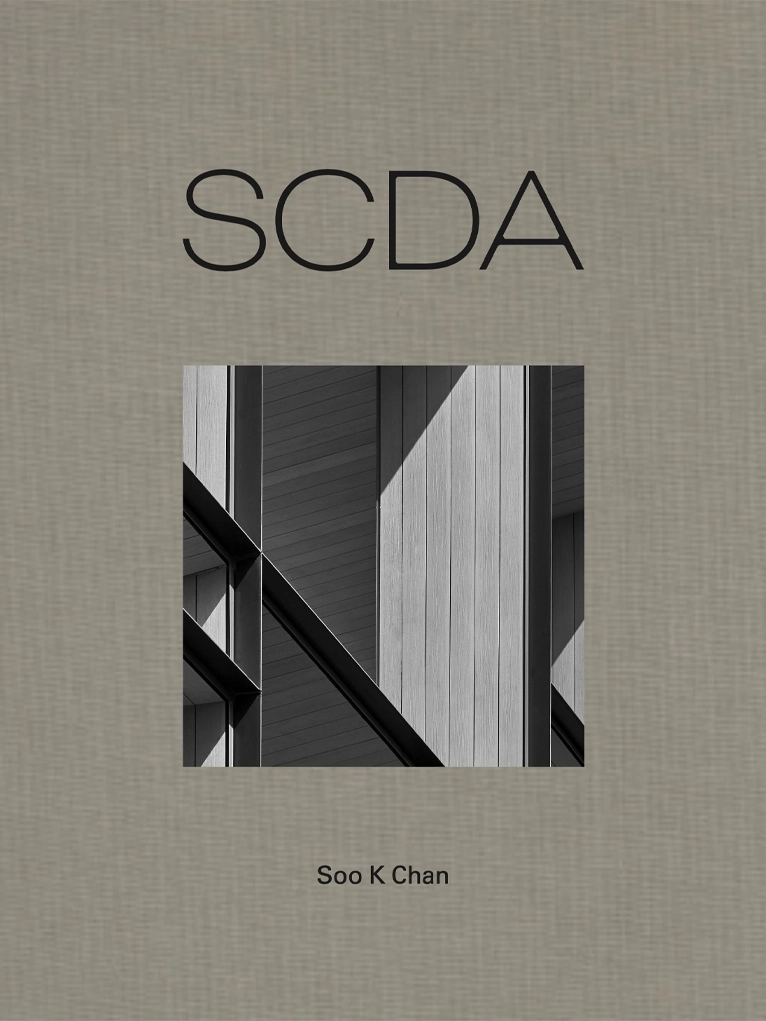
SCDA Architects (2004)
The Master Architect Series VI
The Suspended Architecture of Soo Chan / by Aaron Betsky
Soo Chan cuts corners. He refuses to let rooms remain stable spaces. He creates mirrored versions of the same house next to each other and builds whole neighbourhoods by fitting courtyard compounds, open spaces and roads around each other in meandering patterns. He slices the sides off rooms so they are open to the flows of modern life, and he puts stairs, beams and other protrubances in the middle of what should be open expanses. You would think that this would make the work seem ungainly or uncomfortable, but it only enhances the sense of its rightness.
The easiest explanation for why Chan does this (and clichés become so because they have at least some element of truth) is that his work intersects Eastern and Western influences. He was born in Malaysia and trained in the USA, but works in Singapore where the concept of globalisation seems a natural part of the social and cultural landscape and draws on Eastern and Western traditions. His houses, stores and apartment buildings look like those Modernist structures that tend towards a dissolution into white planes, glass and exposed concrete. Yet their detailing pulls them into the context of the South-East Asian region: sloping roofs appear, as do wood shutters, and the rooms are open to each other to encourage the breezes to cut through the humid warmth. In this sense, Chan's work is part of an emerging 'Pacific Rim' consensus about using globally perfected building technologies and aesthetics developed by Western architects in an idiom, compositional array and material realisation that derives from the local geographic, geological and climatological realities.
It is worth noting that Chan, however, was not trained in the mainstream Modernist tradition. He studied architecture at Yale during the heyday of Post-Modernism, when the thin, minimalist and revelatory methods of high Modernism were distinctly out of fashion. He chose to study with proponents of neo-classicism such as Thomas Gordon Smith and Rob Krier and went to work for one of the most rigidly retardataire practitioners of that mode, Alan Greenberg. Even when he graduated to corporate firms, he chose to find employment with Kohn Pedersen & Fox, who were at the time applying the narrative, referential and metaphorical appendages of Post-Modernism to otherwise meaningless office buildings.Upon returning to South-East Asia, he specialised not in the design of new structures, but in historic renovation. Strangely enough, he seems to have immediately abandoned the stylistic accoutrements of the manner in which he had worked. What he retained was a flexibility about how he used forms and appearances in his work. In this sense, it would be safe to say that Chan is a Post-Modernist. He is a ruthless and effective scavenger of whatever organisational principles he thinks are appropriate for the situation in which he finds himself working. He believes that the memory contained in certain modes of construction are valuable ways of grounding new structures. Yet he also believes that architecture must respond to technologies that are mass produced and global, and understands that he works for a clientele that understands their world as much through CNN as through the stories their parents told them.
The first few major free-standing structuresChan designed, such as the Bishopsgate House of 1996 and the Fifth Avenue House of 1998, mixed bits of stone, wood columns, traditional courtyard floor plans, pitched roofs and a sort of minimally detailed, planar set of walls that one might expect in a completely different kind of house. They were referential and then undercut the stability of the structures to which they referred with flowing, contrapunctual floor plans and pinwheeling planar compositions.The Fifth Avenue House in particular kept these pieces so beautifully in balance that none of the associations one might have with these different elements intrude on one's experience of the whole.The trick seems to have been Chan's discovery of a kind of spatial suspension that keeps one's understanding of the relationship of the different pieces to each other at bay. The courtyard here is a heavily planted pool, around which one circulates through rooms whose walls in some cases start on the second level, as if they were floating on wood columns. Rooms such as the study and bedroom lift up towards sloping ceilings that rise above wood louvres, giving the interiors a similar sense of suspension.As Chan began to edit down the palette with which he worked, the cuts and elongations became more compressed. The East Coast House of the following year is a compressed box that is completely closed to the outside. Here the courtyard has turned into an empty living room whose off-centre focal point is a sunken seating area.Light washes in along the walls in a pattern that
emphasises them as planes and denies the constructional logic that might give them a clear reference point. Just as one might think that Chan was after an effect of weightlessness, however, beams connecting the ceiling plane to the rear wall and a spiral staircase squeezed into a small slot insert a sense of structure and form. Neither an abstract loft nor a figured room, the space hovers. The highly refined detailing, which robs stair treads in beautiful local wood and precious onyx of any visible means of support, furthers this almost uncomfortable sense of a house poised between nothingness and presence.In the Sennett House, Chan achieved this same sense through the simple doubling of the home. The house is really two versions of the same design side-by-side. This duplicate form was the result of programmatic considerations, as the structure houses two families a brother and sister, and their respective spouses and children). The effect is striking. The houses turn twin façades, whose wood shutters and free-hanging planes already dematerialises them above a low wall, toward the street. The courtyard between the structure that follows behind this split face flows into the kitchen and living room areas with glass walls that slide out of sight. Sitting on the couch in one living room, one looks across at a duplicate space. The come-back effect is much more powerful than what Chan achieves upstairs with more cantilevered stairs and suspended glass bridges.In addition to designing a series of such highly refined houses, Chan has also created retail spaces and apartment buildings. In the former, he used
scrims and obscuring glass to play a game of both hiding and revealing the items to be sold. In the latter, he confuses our reading of the height and proportions by grouping floors together, by emphasising structural elements seemingly at random, and by undercutting the different planes whenever hecan.In these larger structures, and also in multiple dwelling projects, such as the housing development outside Shanghai that is currently under construction, Chan brings out the structure behind the suspension.It is a form of 'L' that can work horizontally as a combination of living room and kitchen for instance, or as a relationship between entry and living area. It can act vertically, as interlocking double-height and single-height spaces stacked up in apartment buildings, or it can appear in a large scale, as in the interlocking rows of houses in China. It can also work in physical structure, when plane and beam seem to grow out of each other In all cases, there is a confusion of class or kind, as disparate scales, functions and spaces are melded together. What Chan keeps separate is material, so that the confusion gains by the inarticulation of different textures, colours and associative elements.Why does Chan do this, and does he do so consciously? He claims not to use these methods deliberately, and prefers to speak both of his love of Modernist painting and his desire to respond to local conditions, such as solar, wind direction and topography. These are logical explanations that one should take seriously. Perhaps one can also, however, see his architecture as emerging out of an intersection between a Western aesthetic and Asian conditions, but it might not be that easy to move from local conditions and global technology to an integrated response. There seems to be, rather, a kind of uncomfortableness about his situation that he makes productive. Working in Singapore, where English is spoken in the tropics, the whole island is about to become a city as well as a geographic entity, and trade, commerce and shopping are the main industries. There is a sense that he is operating in a kind of suspended artifice that slides into the jungle and away again on the next container ship or jumbo jet. To make something in Singapore you cannot be too definite, and Chan is a master of suspended disbelief.Of course, this is only a sense one gets after a glide through Chan's buildings. His work has been limited in its scope and in its situation. That, however, is now changing as he is currently designing a columbarium, a toy museum, a retail village and a school. It will be interesting to see how his approach develops, not just in its sophistication and mature response to its context, but also in sites as disparate as India and Connecticut, USA, where he is currenty designing projects. This writer senses both a suspension of disbelief in the compatibilities of many different traditions and technologies, and a belief in the certainties that architecture can provide. It seems like one can waft quite comfortably and elegantly through this suspension.
The Choreography of Space / by Robert Powell
Soo Chan (Chan Soo Khian) is one of a growing number of young architects who are making a substantial contribution to the built environment of the burgeoning cities of South-East Asia.It is more than a decade since he relocated toSingapore after completing his studies and architectural internship in the USA. He set up a design studio in the South-East Asian city-state in 1995 and two years later established SCAArchitects. From the Singapore base, the practice is now building in India, China, Malaysia, France and the USA.At the beginning of the 21st century, he is concerned with refining a modern tropical architectural language. In the process of"confronting his own roots in South-East Asia, he has developed new solutions that mediate the universal with the locally specific.Born (1962) and raised in Penang, an island offthe west coast of Malaysia, Chan left home as a teenager to undertake his architectural education at Washington University and Yale University. The whole of the 1980s were spent in the USA.After finishing his Bachelor of Arts at Washington University, where he was introduced to the inter-disciplinary methodology of the Bauhaus and the Dutch De Stijl, particularly the works of Theo van Doesburg (1883-1931), the Hungarian artist László Moholy-Nagy, and Kasimir Malevich (1878-1935), Chan went on to study architecture at Yale University, School of Art and Architecture.The advanced architecture studios had a roster of rotating chaired professorships held by distinguished practitioners. In addition to the usual elective in art history, Chan pursued classes in the School of Fine Art in sculpture, painting and photography.
Discussions at the school of architecture in the1980s centred on issues of urbanism, representation and meaning against the framework of ongoing post-structuralist discourse. Against a backdrop of diverse design philosophies, Chan took a conservative route and attempted to ground himself in classicism. This inevitably influenced his choice of studios by Rob Krier, Thomas Gordon Smith and Robert Venturi, and upon graduation his internship at the office of Allan Greenberg, a classicist architect. The notion of order; hierarchy, proportion, scale and composition was ingrained in him. In retrospect, he believes that the early grounding that he received in the classical language of architecture significantly influenced his development as an architect. It was a point of reference from which he went on to appreciate the works of the Modern masters: Louis Kahn, Mies Van der Rohe, Frank Lloyd Wright and Le Corbusier:The two Kahn art galleries at Yale were a point of reference for him to develop a structural and spatial vocabulary—a language of volumes and planes enhanced by light and structural order: The notion of implied centres was firmly established as a loci for orientation. The humanist tradition of classical architecture and the formal and spatial plasticity of the Dutch De Stijl were notable influences in his later works.In 1991, his internship with Kohn Pedersen Fox in the USA completed, he decided to relocate to Singapore, In part, this was motivated by a desire to reconnect with his Asian roots after spending almost a decade in the USA. In the tropics the ambiguous boundary between interior and exterior spaces and the spatial engagement with landscape, became an important agenda in his work. He established a network of contacts and, in 1995 set up Chan Design Associates (SCDA), initially as an interior design studio. Two years later, after obtaining his license to practice in Singapore, he extended operations into architecture where he subsequently made a substantial impact in a succession of consistently well-designed conservation projects, private houses, and commercial interiors.Space, Light and Structural OrderThe design process starts with the careful consideration of programme and site as part of the overall matrix for generation of ideas. The works are informed by the cultural and climatic nuances of the context and seek to capture the essence of'place. The designs strive for tranquillity and calmness enhanced by space, light and structural order. The free plans in the designs are grounded in classical ideals of scale and proportion. The spaces within the 'free plans' overlap and are further defined through the careful placement and clear expression of walls and ceiling planes that intersect with or 'slide by' each other. Compositionally these walls propagate from multiple 'centres' within the flowing spaces. These 'centres' implied within the open concept planning are reinforced when the spaces are experienced sequentially and hierarchically through choreographed processions that recentre and realign the perceptual 'axis' that terminates in objects, landscaped vistas or open spaces. These spaces are designed to heighten the experience of sound, touch, smell and sight, unfolding sequentially as one moves through the spaces. Mechanical and electrical services are often grouped as service 'walls' and 'cores' in deference to the served spaces. Order is emphasised through a clear expression of structure.'
Soo Chan (2001)
Chan does not consciously attempt to design with an Asian identity. Several projects reference the traditional vernacular of the tropics, but he is committed to refining a modern architectural language and simultaneously rethinking typologies.His latest work endorses my view that he is moving towards a clear, critical position that captures the spirit of a specific place by simultaneously considering closely the culture and the climate.Chan is involved in a continuous exploration of the 'Choreography of Space' and in speaking of his work he refers to five attributes namely Light, Space, Structure, Transparency and Texture! These properties are uncannily close to the guiding principles of Louis Kahn (1902-1974) whose work was also rooted in classical grammar, with devices of axial organisation and composition. Not surprisingly Kahn's design for The Yale Art Gallery (1951-53) is one of Chan's favourite buildings. Kahn believed the very basis of architecture to be the'making' of space. He wrote: 'If | were to define architecture in a word, I would say that architecture is a thoughtful making of space. It is not filling prescriptions as clients want them filled. It is not fitting uses into dimensioned areas. It is creating of spaces that evoke a feeling of use. Spaces which form themselves into a harmony good for the use to which the building is to be put. I believe that the
Introduction / by Soo Chan
It is always a difficult proposition to begin to write about the process that goes on in the making of one's own architecture. To do so requires sustained introspection and an ability to be open. The process of design by its very nature is fluid and is always evolving. What is constant is the recurring organisational strategies that manifest themselves in different forms to address the given brief in a particular site. The objective in writing this essay is to discover the common threads fundamental to the works in this monograph. In the process, a dozen houses are analysed and it becomes evident that there is an empirical spatial and organisational strategy behind all the projects. The works are typologically driven and the spaces are classical in spirit.To understand one's own architecture requires an understanding of self. We are a product of the sum of all our experiences and this is true of architecture as well. The influence of my training in the early 1980s and coming into contact with influential mentors played a big part in my own development as an architect. At Yale, I remember Rob Krier's passion for architecture as he recounted over beers at the campus pub the number of competitions he did not win. Robert Venturi talked about the fact that it was always the small things that kept him awake all night. It was the early 1980s, a time when architecture was very inclusive. I recall students aligning themselves with different camps: the Post Modern historist, the Neo-rationalist, the Orthodox classicist, etc. Many spontaneous discussions took place at the sixth floor review pit at Paul Rudolf's Art and Architecture building late into the evenings.I remember my early grounding in design under a particularly inspirational teacher by the name of Leslie Laskey at Washington University, who conducted the design modules in the curriculum of the Bauhaus. He was shaven bald, dressed in black and I was sure he was modeling himself after Oscar Schlemmer of the Bauhaus school. The lessons learnt of the utilitarian nature of design achieved through an economy of means, and a concern for materiality stayed with me. Later at the advance studios at Yale, I signed on to a Classical design studio under Thomas Gordon Smith but quickly realised that I did not belong in that studio.I found the treatises too dogmatic and never drew a single classical column in the semester. The presentations were to be in the form of the very tedious watercolour analytiques, a composite of plans, elevations, sections and details composed on a single board. The emphasis was on learning by rote the rules and syntax of classicism.
Even though I did not indulge in classicism in studio, I was freelancing with another student, Tim Steele, on a law office conversion in the evenings.The project we designed was orthodox classical and was replete with the Tuscan columns at the portico entrance and ionic columns in the Library, It was the beginning of an uneasy relationship with classicism. While I found it restrictive, was also moved by its ability to produce grounded monumental spaces. At the final studio review at Robert Stern's New York office, Philip Johnson refused to discuss my project as I had not presented any elevations. The façade was presented as a blank wall against the existing Romanesque façade of the museum. I was interested in talking about concepts and spatial metaphors for the Harpsicord Museum addition. It was a time when appropriating a source and borrowing the façade to reinterpret could form the basis of the entire review; but the critics were interested in discussing styles. So it was that I never felt aligned to any particular movement. Upon graduating I sought an internship with the most orthodox of architects, Allan Greenberg, who did work in the White House and the State Departments. My visits to Rome after graduation confirmed my conviction in the ability of classical spaces to move the human spirit.I shall attempt to define a design methodology in the works of SCDA. The projects designed at SCDA refer to the fundamental elements of architecture (light, space, transparency, materiality and order) and aspire to humanist qualities such as serenity, beauty and order. The spaces are composed to be experienced sequentially througn choreographed processions that recenter and realign the perceptual 'axis', terminating in landscaped vistas or open spaces. The approach is phenomenological and is about the emotional response of the user to the space. The figure of the architectural forms, which are often a series of rectangular boxes, defined equally important courts gardens and other external spaces set against the walled boundaries of the lots. The lots tend to be fairly rectangular and when it is not the differences are usually taken up by shrubs or landscape as Poche. This organisational strategy allows for the concept of 'inversion. This can be interpreted architecturally as the building and outdoor court spaces (grounds) being given equal importance and weightage. This strategy has been applied to projects such as the Heeren Street House in Malacca the Emerald Hill House and the Sennett House, among others, where the diagram of the expected open spaces (grounds) has been used to generate the building form.
The interstitial spaces between the building and its perimeter boundaries often created by zoning bylaws as setbacks are claimed to become defined view courts. Corners of rooms are often cut to destabilise the space propagating it outwards towards the garden or courts while allowing for possibilities of refocusing the spaces centrifugally towards internal courts in the more urban typologies.Large sliding doors that disappear into pockets blur the interior zone to the fully exterior surface.In the increasingly urbanised suburbs of Asia, there is a need for controlled views to ensure privacy of the occupants and this is manifested in the introduction of small courtyards and lightwells within the plans. The incorporation of vernacular features in the early projects relied more on the imagery of the large overhanging hipped roofs of the colonial black and white bungalows. With time the projects began to evolve into more subtle compositions of spaces based on abstracted forms and on the circulation patterns of Asian dwellings.The architectural language established in the designs allows for typological interpretation for the houses we designed in South Asia. Projects, particularly the residential developments in the tropics, focused on the treatment of the 'in-between spaces' or the ambiguous boundaries in between the inside and outside that are an integral architectural response to the climate of the tropics.The device deployed (the perforated surface, the tectonic screen or lattice of timber, metal or masonry) is manually or mechanically operated to temper the heat and glare of the sun in the equatorial climate. This screen, which is the staple of vernacular tropical house, is the mediating element between the opaque walls and the transparent glass fenestrations. This architectural veil alters the quality of light and shadow. It dematerialises surfaces and allows for translucency or opaqueness when strategically lit.Liberated from notions of representation and the vernacular, the massing and façade is built on archetypal elements, of volume, light and surface.The walls are treated as separate planes allowing for physical material separation between walls.While this vocabulary provides possibilities to re-interpret and transform the spatial essence of a given vernacular, it is also able to incorporate the rudimentary elements of place making through considered interpretation of local craft, culture and climate.
The Traditional Shophouse: Rethinking Conservation
'SCDA's approach towards shophouse conservation design aims to preserve the salient characteristics of sectional interest and episodic spaces while transforming - with the introduction of a rich variety of new materials - its identity into a dignified architectural statement of contemporary urban habitation.
Responding to the insular form of the shophouse these designs strive for tranquillity and calmness amidst the chaos of the city.
Aesthetically distilled, these works are also motivated by the cultural and climatic nuances of the context, integrating landscape, air-wells and water features.
An important idea is that of 'procession' juxtaposed over the sequence of spaces both in plan and section - movements are choreographed to amplify the rhythm and spaces of the architecture.'
Soo Chan, September 2001.
The 'shophouse', an urban rowhouse typology prevalent in Singapore during the late I9th and early 20th centuries, is typically narrow and long, between 5-6 metres wide and 20-40 metres deep. The typology's distinctive features are the front verandah (five-foot way), the courtyard separating the front living quarters from the rear service wing, the three-bay façade and the pitched gable roof. In many parts of Singapore, the authorities require that the exterior features of the shophouse be retained while the interior spaces may be reworked.
One of Chan's first shophouse projects was the thoughtful conversion of a terraced Peranakan shophouse in Koon Seng Road, Singapore. Designed for his own family and completed in 1992, it displayed meticulous attention to detailing and was published in Living Legacy. At the time many shophouses, relieved of rent control, were being conserved with very little flair. Numerous architects, with little conservation experience, slavishly followed the Urban Redevelopment Authority (URA) conservation guidelines.
But Chan was among the few who questioned conventional ideas on conservation in the Singapore context.
The design was sectionally driven and the plan being only 5 metres wide, was seen as a progression through a series of spaces to be experienced from a predominantly single perspective. The interventions were clearly expressed against the existing 'shell', thus differentiating the new from the old.
The ubiquitous airwell or lightwell is an important part of the house and it led to speculation on different ways to utilise this vertical shaft of daylight. This would be further developed in later designs.
Not surprisingly, in the light of his success with the Koon Seng Road project, one of the first commissions to come into the office when SCDA was set up, was another terrace house at 122 Cairnhill Road. In the Cairnhill Road House (1995) he radically altered the spatial hierarchy of the rowhouse by the insertion of lightwells of varying depths.
This strategy is one that would be continuously refined by SCDA and later it is introduced into individual new house and medium-rise condominiums.
Shortly after commencing the design of the Cairnhill Road House, another shophouse conversion was commissioned at Teck Lim Road. The Tolman Gallery (1996) was specifically designed for the Tolman Collection, which specialises in contemporary Japanese prints. Layers of screen walls and zones of light and shadow structure the interior space, which occupies the first storey of a conserved shophouse. The idea of depth (oku) and asymmetry, rather than a centre, order the spatial arrangement, resulting in a balanced composition.
In 1996, Chan was commissioned to conserve 72 Cairnhill Road to form The Cairnhill Gallery for the display of sculpture. The façade was restored to its original condition and reveals nothing of the internal transformation. Internally, the architecture is pared to the essential elements: along a shifting axis, light, space, volumes and planar surfaces concentrate the eye upon the sculptural objects on display.
The following year, at 95 Emerald Hill, just outside the Emerald Hill Conservation Area, Chan critically confronted the guidelines set for houses within the Conservation Area.
He chose not to retain the existing façade or, indeed any of the interior. Everything was erased and then memory was invoked to recreate a new terrace house that embodied the spirit of the past yet was not a literal copy. An exhilarating central atrium was created and this device would later be explored in several commissions for new houses.
Subsequently other commissions came from the same client, the conservation of five shophouses at Kim Yam Road (1996) and three more in Koon Seng Road (1997).
In 2002 Chan completed a conservation project that pushed his ideas on conservation still further. In the conservation of Heeren Shophouse in Malacca, he comes close to the principles espoused by Carlo Scarpa who believed that true conservation should respect the past and do no more to the existing structure than was required to make it stable and safe. Any new accommodation should be absolutely of its time using modern technology, reflecting contemporary needs and values.
SCDA brought their accumulated experience to the design of two new conservation projects completed in 2002: a colonial-era Black-and-White House at Dalvey Estate and a shophouse at 153 Neil Road. Both won URA Conservation Awards in 2003.
In each of these conservation projects, Chan makes an important contribution to conservation practice in Singapore and Malaysia. He critiques the mimicry of the past, which was prevalent in the 1980s, and introduces elements of a modern architectural vocabulary into the shophouse design to radically rework the shophouse typology.
Private Houses: Reinterpreting the Vernacular
Working within the framework of a given vernacular presents opportunities to study and reinterpret inherent spatial typologies and their relationship to climate and place. Construction, craft, and material are integrated through careful assemblage of the various components. The inherent beauty of the natural materials used is easily appreciated through the clarity in construction details.
Spaces are often characterised by their relationship to courts, pools and landscape - engaging the elements and grounding the project in the climatic nuances of place.'
Soo Chan, January 2002.
Several residential commissions were secured early in 1995, shortly after the establishment of SCDA, including a large family residence on a substantial plot of land in Bishopsgate, Singapore. The house is inspired by the spatial relationships of rooms to intimate landscaped courtyards which is the essence of the South-East Asian vernacular.
It also references the architecture of Frank Lloyd Wright in its formal vocabulary and in its spatial and structural agenda with 'floating roofs and steel corner windows'.
With the design of the Bishopsgate House, Chan begins a process of transition from his American education to the process of architectural practice in Asia. Even as the house exhibits, in its roof-form and in-between spaces, an affiliation to the tropical vernacular, it also connects with the classical notion of hierarchy, procession and recentering, notably through a series of axial movements. The micro details of the house are contemporary - the introduction of steel to complement the wooden structure injects visual lightness to the project.
This house was commissioned while Chan was still employed by Architects 61, the architectural practice he had initially joined upon his arrival in Singapore. The house gave an indication of Chan's progress in resolving the apparent contradictions between a rooted culture and the global forces that increasingly propel architecture.
In 1998 SCDA was commissioned to design a large residence in Ford Avenue. While the form of the house with its low pitched roofs, overhanging eaves and horizontal emphasis once again strongly hints at the overt influence of Wright, the roof material is on this occasion aluminium shingles and the overall impression is of a much less bulky roof mass. The house again flows into the landscape in a manner reminiscent of Wright.
The Fifth Avenue House, commissioned in 1998, takes the process of transforming the vernacular to another level. It is in a transitionary architectural language, located somewhere between the vernacular inspired Bishopsgate House and the Modern architectural language that SCDA adopts on several houses being designed concurrently. The manner in which one moves around the courtyard at Fifth Avenue is reminiscent of a Chinese courtyard house. Circular timber columns that support the low verandah roof are a link with the vernacular, but otherwise the language employed is entirely Modern.
One might call it a hybrid form, for in a shift from the overtly vernacular style of his earliest houses Chan again dispenses with clay tiles and opts for a copper roof, which is appropriate for the Modern form and monopitch section.
It gives the house a 'lightness' that is not present in the vernacular language.
The Sunset Place House (1999) has a discernible duality in its language. SCA's design embraces some elements from the language of De Stijl. The result is a distinctly Modern house, with interlocking volumes, bounded by planar white surfaces and a shallow-pitched, copper-clad roof with wide projecting eaves.
The Oriole House (1999) is yet another convincing development of a hybrid vocabulary. There is a horizontal emphasis in the built form with a light copper clad roof and wide extended eaves. The fenestration, too, emphasises horizontality. The house, completed in 200l, takes Chan and SCDA a further step forward towards compiling a Modern architectural language for tropical Asia.
The final house in this chapter, the Victoria Park House (200l), continues SCA's exploration of a modern language rooted in the South-East Asian context.
Private Houses: Refining a Modern Language
The contemporary dwelling aims to respond to the requirements of building within the region with formal and spatial solutions that are not derived directly from the vernacular tradition. The language deployed allows for a clear reading of the archetypal elements of solid, void and plane. With the use of devices such as screens and light-courts, the vocabulary caters for specific programmes and for rudimentary concerns for comfort and shelter.
The universality of the vocabulary allows for the works to transcend place. The reference to the locale is often through construction, craft and culture.
An important aspect of this architecture is the tectonic screen, a perforated surface of timber, metal or masonry. These screens serve as mediating elements between the interior and exterior spaces, allowing for privacy, shade and shadow?'
Soo Chan, January 2002.
In 1995 Chan was commissioned to carry out substantial alterations and additions to a house with art deco details at 15 Wilmonar Avenue in Singapore. The result was a distinctly Modernist solution that propelled Chan to seek a relevant architectural language for the tropics that paralleled the language of the traditional vernacular.
In 1996, while working on the Carpmael Road House, Chan initiated a detailed investigation into the louvred screen, an indispensable element of vernacular Asian architecture, It later became a fundamental part of the practices repertoire of responses to the tropical climate. The facade of the Carpmael Road House, a rebuilt rowhouse facing the public street, is a giant louvred screen. One metre back from the screen are sliding, powder-coated, aluminium-framed windows.
This was the beginning of the exploration of the façade as a 'double skin'. The first layer provides shade and the space between allows for heat transfer via convection. The enormous potential of the louvred screen becomes apparent in this project. Apart from providing shade, the translucent screen has seductive, even erotic qualities, It simultaneously reveals and conceals, It permits anonymity, yet exists at the interface of voyeurism and exhibitionism.
In the Walmer House, commissioned the following year, two evolving themes in SCDA's architectural vocabulary were further refined. Firstly, the transformation and incorporation of elements of the shophouse typology, particularly the internal courts, into a detached house. And secondly, the evolution of various types of louvred screen to ensure the privacy of people living in close proximity. The poetic opportunities in this latter architectural device were not lost on the architect, who transformed the louvres into sensual "veils" in addition to pragmatic protective 'outer garments'.
The Walmer House also presented a clear expression of planar elements-both vertical and horizontal--and played down the celebration of entry by chanelling visitors through a detached gable wall-an in-between space-to arrive at a centrally located principal entrance.
As Chan notes:
'The modern courtyard house has evolved as a response to the increasingly tight suburban lots and the need to use the side setback, and the front and rear setbacks as "viewing courts". The courts become a means of activating a new spatial dimension through the re-orientation of space either centrifugally inwards or centripetally outwards-allowing for a dialogue between the interior and the exterior spaces. Large sliding glazed doors make the enclosure disappear. The courts are used in conjunction with vertical airwells and lightwells—a staple of the shophouse typology which are deployed with varying levels of penetration.
The East Coast House (1996) continued the development: of a Modern architectural language. This house, built for a single man and his mother, is essentially a three-storey rectangular 'box. As there are no views to be exploited, Chan focuses the semi-detached house inwards the interior has been crafted employing planes, surfaces, voids and natural daylight to produce multiple spatial experiences within the finite volume. The parti is derived from the shophouse typology and the design consists of two three-storey accommodation blocks separated by a light-filled atrium, which is analogous to the shophouse airwell. The services and two smaller courts are located in a narrow band alongside the party wall, while a detached screen wall allows daylight to slip into the building while simultaneously restricting views from the adjoining house.
The subsequent design of the Sennett House (1997) involved a rethinking of the semi-detached house typology.
The client owned two semi-detached houses that faced each other across a boundary fence. These were demolished and replaced with two linear units. The units are mirror images of each other separated by a central courtyard. Each is occupied by one of two siblings and their families. The existing party walls extend from the front to the rear building lines and present formidable barriers to the neighbouring houses. The semi-detached house typology is stretched and turned inwards to address the central courtyard. The changing axial movement evident on other SCDA houses is also introduced here. The built form addresses social issues of extended family co-habitation in an increasingly urbanised suburbia.
The Coronation Road West House 1998) affirmed SCDA's increasing commitment in the late 1990s to the language of Modern architecture. Other than the horizontal timber louvres, there is no trace of vernacular architectural elements. The assured and uncompromising design has a reductionist quality reminiscent of the interlocking volumes and planes in the early Modern architecture of the De Stijl group, for example the Schroeder House (1924) in Utrecht designed by G T Rietveld. What William Curtis has termed a "centrifugal conception of space with planes extending into the surroundings" —evident in numerous De Stijl projects-is apparent here. It is a reminder of Chan's intensive grounding in the work of the early Modern masters in his undergraduate education.
The Namly Hill House (1998), completed in March 200l, deploys a light, 'floating', curved copper-clad roof that Chan had earlier explored in the Carpmael Road House and the Berjaya House. The Modern language is also apparent in the circular structural columns and the lighter, more transparent aesthetic achieved by the use of aluminium, steel and glass. A complex brief and demanding site are translated into a house of the utmost simplicity. The volumes are clearly articulated with different claddings of stainless steel mesh, timber and
The Andrew Road House (2002) continues Chan's exploration of a Modern architectural language with a balanced asymmetrical composition of three flat-roofed blocks on a sloping site. The interlocking of geometric and planar forms is also evident in Janda Baik (2003), a holiday retreat on a forested hill on the east coast of peninsular Malaysia. The two interlocking volumes are stacked and staggered to reconcile the sloped terrain. Similarly, a series of houses at Damansara Heights in Kuala Lumpur are set against steep slopes and are designed to engage the terrain with minimum cutting and filling of the earth.
The final house in this chapter brings Chan full circle. The Prickly Pear (2003) is located in the Hudson River valley, in Weschester County, New York. Thirteen years after quitting the USA to set up practice in South-East Asia, Chan returns to the country where he received his architectural education. The house is oriented southwards towards the view of the Hudson River and to maximize heat gain in the winter. One single storey box is totally glazed with another more enclosed volume housing bedrooms and services. The glazed box-like form of cedar wood is a cross between the early Usonian houses of Wright and the structural simplicity of Mies' Farnsworth House.
This array of contemporary houses demonstrated a consistent approach that addresses the nuances of site, climate and construction.
I William JR Curtis, Modern Architecture since 1900, Phaidon,
Oxford, pp 98-99
Multiple-unit Dwellings: Interweaving Space
The challenge is to design multiple unit dwellings that address issues in urban tropical living. The spatial module of each unit can be conceived to interlock or slide by each other, opening up possibilities of introducing internal lightwells and courtyards in multi-level dwellings. These courts in the sky can engage the tropical climate while resolving issues of privacy simultaneously?
Soo Chan, September 2003.
In 1997 the Singaporean housing market underwent significant changes. In an over-supplied market, discerning buyers and developers placed a greater emphasis on innovative design, and several influential residential projects attracted the attention of local and international journals, including the work of SCA. As a result, SCDA won several new commissions for 'boutique condominiums' designed to appeal to certain niche markets: young, first-time buyers or families upgrading from public housing.
The Mondrian (1997) was one of the earliest responses to this new market. The name of the residential development is a reference to Piet Mondrian (1872-1944), a painter and one of the founders of the Dutch abstract group of artists, De Stijl. The Mondrian is a low-rise development of semidetached houses and bungalows on the edge of the protected Bukit Timah Nature Reserve. The interlocking geometry and the expression, on the elevations, of the sectional relationships within the residential units, recalls the abstract compositions of the Dutch artist.
The Lighthouse (1997) is another 'boutique' development on the northern coast of Singapore in close proximity to the Straits of Johore. The 5l-unit development has three, four-storey blocks of differing configurations arranged around a
25-metre (80-foot) swimming pool. Eighteen of the units have roof terraces with views of Pulau Ubin to the north.
In the adaptive re-use of inner city shophouses, Chan has used several variations of the traditional lightwell and in the Lighthouse this experience is utilised. The architect has manipulated lightwells of varying depths in order to introduce daylight into the narrow fronted, deep-plan units.
Typically, a lightwell brings sunlight into a courtyard overlooked by an internal dining area or it spills light into what would otherwise be a dark internalised corridor.
In the Ladyhill Condominium (1999), a 55-unit development commissioned two years later, the linear form of the site and the topography were major determinants of the layout. This was resolved as two parallel, four-storey, terrace blocks facing a central, linear landscaped courtyard.
But the principal influence upon the design of the individual apartment units is the shophouse conversions that Chan carried out at 72 and 122 Cairnhill Road in 1995. In these earlier projects the adaptable quality of the internal lightwell was revealed'. Later, in individual house projects such as the East Coast House and the Sennett House, interlocking spatial volumes were devised and introduced.
The accumulated experience was then brought to the design of the Ladyhill units.
SCDA's strategy is to introduce daylight into the centre of the plan at each level in the form of a lightwell. But this is not a conventional lightwell. The geometry permits daylight to penetrate to the lowest of the four storeys, without the lower apartment being overlooked by the upper units. The Ladyhill condominium thus continues Chan's commitment to the critical analysis of housing typologies.
In addition to low-rise condominiums, from 1999 onwards SCDA was commissioned to design a number of high-rise apartment towers. The Lincoln Modern (1999) is one such 30-storey condominium comprising 56 split-level apartments, studios and penthouses. The parti for the project is four, closely bound, rectangular vertical towers separated by two sets of parallel walls intersecting at right angles at the centre of the plan. Three of the vertical towers contain residential accommodation and the fourth contains an escape stair and service ducts. The lift core is located in the central space.
The residential apartments in the Lincoln Modern make reference to principles first explored in Le Corbusiers two-storey prototype dwelling from the Immeubles-Villas project of 1922, which was subsequently displayed in the Esprit Nouveau Pavilion at the Paris 1925 Exhibition. In the Lincoln Modern, Chan applies these ideas to a high rise residential project in the same manner that Le Corbusier used a double-height living room with a single-height bedroom zone in the Unité d'Habitation in Marseilles, which was completed in 1952.
The influence of Mies van der Rohe can also be detected in Chan's architecture. It can be discerned in the principles of overlapping space without recourse to a dominant axis and the technical perfection in the detailing. The architectural language of Chan's high-rise towers, with the use of slender aluminium brise-soleil and smooth curtain walling, emphasises elegant transparency just as did Mies van der Rohe's seminal Lake Shore Drive apartments designed in 1948.
The potential of louvred screens, which Chan had explored in private houses, is examined in the context of high-rise apartments and a variety of different designs are introduced to envelop or conceal stairs, lifts, air-conditioning equipment and service yards in addition to providing privacy and shading to habitable areas.
SCDA subsequently produced designs for BLVD at Cuscaden Road (1999), the 15-storey Abode at Devonshire (1999), and the Sentinel (1999), a 16-storey tower in close proximity to Newton MRT station. These luxury residential towers incorporate further developments of full-height, double-glazed aluminium curtain walls with integral louvred screens.
In the BLVD development, sky terraces accommodate an outdoor gym, viewing lounges and landscaped gardens-in-the-sky. The elevations express the duality in the plan arrangement. One façade has full-height double-glazed curtain walling, the reverse elevation is clad in a screen of perforated metal that runs the full height of the building. In the Sentinel the west-facing service elements are clad in a unique woven" perforated aluminium screen developed by SCDA Architects.
And in the Abode at Devonshire the east and west facing elevations are clad in double-glazed curtain walling incorporating perforated silver-anodised, aluminium louvres.
Holland Mews (2002) continues SCDA's exploration of the condominium typology and the louvred screen. A five-storey apartment block at the north end of the site acts as a physical buffer between the heavily trafficked main road and the quiet garden space that separates this large block from the two-storey terrace block at the southern end of the site. A stainless steel fabric screen projects one metre in front of the entire northern façade of the tall apartment block to create visual privacy. Holland Road is the site of another project won by the office in 2003. Dragon Court is a low-rise residential development directly opposite the Singapore Botanical Gardens.
Outside Singapore, in 200l SCDA was commissioned to produce a masterplan for a low-density development of 300 residential units at Qing Pu, Shanghai, as well as several other masterplans in Beijing, Shanghai and Bangkok. The plan for the Qing Pu project juxtaposes an orthogonal grid and a network of canals. It draws precedence from traditional water towns in Suzhou. Four prototypical house plans have been developed with a total of 12 variations. The following year the practice was commissioned to design another major project in Shanghai, this time on the North Bund (2002). The 75-metre-high tower is a mixed-use development incorporating residential, commercial and retail facilities that is intended to be a landmark in the CBD.
Soi Polo (2002) is another overseas project. Located in the heart of Bangkok, the site is in a dense urban environment and is bounded by a freeway. The development consists of single loaded plans in the form of high-rise apartment blocks that are located around the periphery of the site to create a barrier to the noise pollution, and villas and townhouse, which are centrally located in a landscaped, garden setting. In 2003 Chan was commissioned to design a I0-storey condominium at Jalan Madge in Kuala Lumpur, Malaysia. The elevations of the project, in a similar manner to the Lincoln Modern, dramatically express the two-way interlocking geometry of the apartments both in plan and in section and deep horizontal and vertical fins provide sun shading. The notion of interweaving space is once again the parti for the design.
This process of understanding by rote the basic building blocks of the architecture is not unlike the training in architecture in the Beaux. One must not confuse a consistent design language with a familiar style. I must stress that this approach has not in any way diminished the ability to layer a process and concept-oriented approach with the design practice; while the spirit of the spaces are classical, the details are universally modern.In the late 1990s, new commissions of high-riseapartments that eventually came into the office provided opportunities to interpret typical low-rise spatial typologies into contemporary high-rise multi-unit dwellings. The opportunity to test the ideas came with the commission of two pivotal projects in 1999, the Lincoln Modern and the Ladyhill.In both projects, the spaces are conceived to be plastic and configured to interlock or slide by each other creating pockets of'courtspaces in the sky.In the Lincoln Modern, the L-shaped sections of the units interlock and express themselves in the façade, an ode to Corbusier's immeubles villas.The result is three storey sky lobbies at each interlocking module, which is in turn expressed directly in the elevation. These three storey lobbies are conceived as sky terraces, bringing tropicality to the high-rise typology. In the Ladyhill, the six internal courtyards became the organising figurative space and interlock to form a rectangular volume. The apartment spaces are then organised around this spatial core.The interior spaces within the projects are the continuation of the architecture and within a reductivist aesthetic. The process of space-making is through clarifying structure and construction by expressing them as a composition of intersecting volumes, surfaces and planes. The palette deployed is natural and monolithic materials that are kept separate to each surface to clarify its formal composition. The manner of distilling the spatial ideas to their very essence - as dictated by the program - allows the subtleties and tectonics of the materials to express themselves. To transcend utilitarian concerns of program, the interior spaces are designed to achieve tranquility defined by clear spaces, light and composition.Increasingly, as practice becomes globalised, the applied design vocabulary has to absorb nuance of climate, culture and place. Working with a clean design language allows for the reconciliation of issues of universality versus regional specificity.
SCDA Architects (2004)
SCDA Architects (2004)
The Suspended Architecture of Soo Chan / by Aaron Betsky
Soo Chan cuts corners. He refuses to let rooms remain stable spaces. He creates mirrored versions of the same house next to each other and builds whole neighbourhoods by fitting courtyard compounds, open spaces and roads around each other in meandering patterns. He slices the sides off rooms so they are open to the flows of modern life, and he puts stairs, beams and other protrubances in the middle of what should be open expanses. You would think that this would make the work seem ungainly or uncomfortable, but it only enhances the sense of its rightness.
The easiest explanation for why Chan does this (and clichés become so because they have at least some element of truth) is that his work intersects Eastern and Western influences. He was born in Malaysia and trained in the USA, but works in Singapore where the concept of globalisation seems a natural part of the social and cultural landscape and draws on Eastern and Western traditions. His houses, stores and apartment buildings look like those Modernist structures that tend towards a dissolution into white planes, glass and exposed concrete. Yet their detailing pulls them into the context of the South-East Asian region: sloping roofs appear, as do wood shutters, and the rooms are open to each other to encourage the breezes to cut through the humid warmth. In this sense, Chan's work is part of an emerging 'Pacific Rim' consensus about using globally perfected building technologies and aesthetics developed by Western architects in an idiom, compositional array and material realisation that derives from the local geographic, geological and climatological realities.